
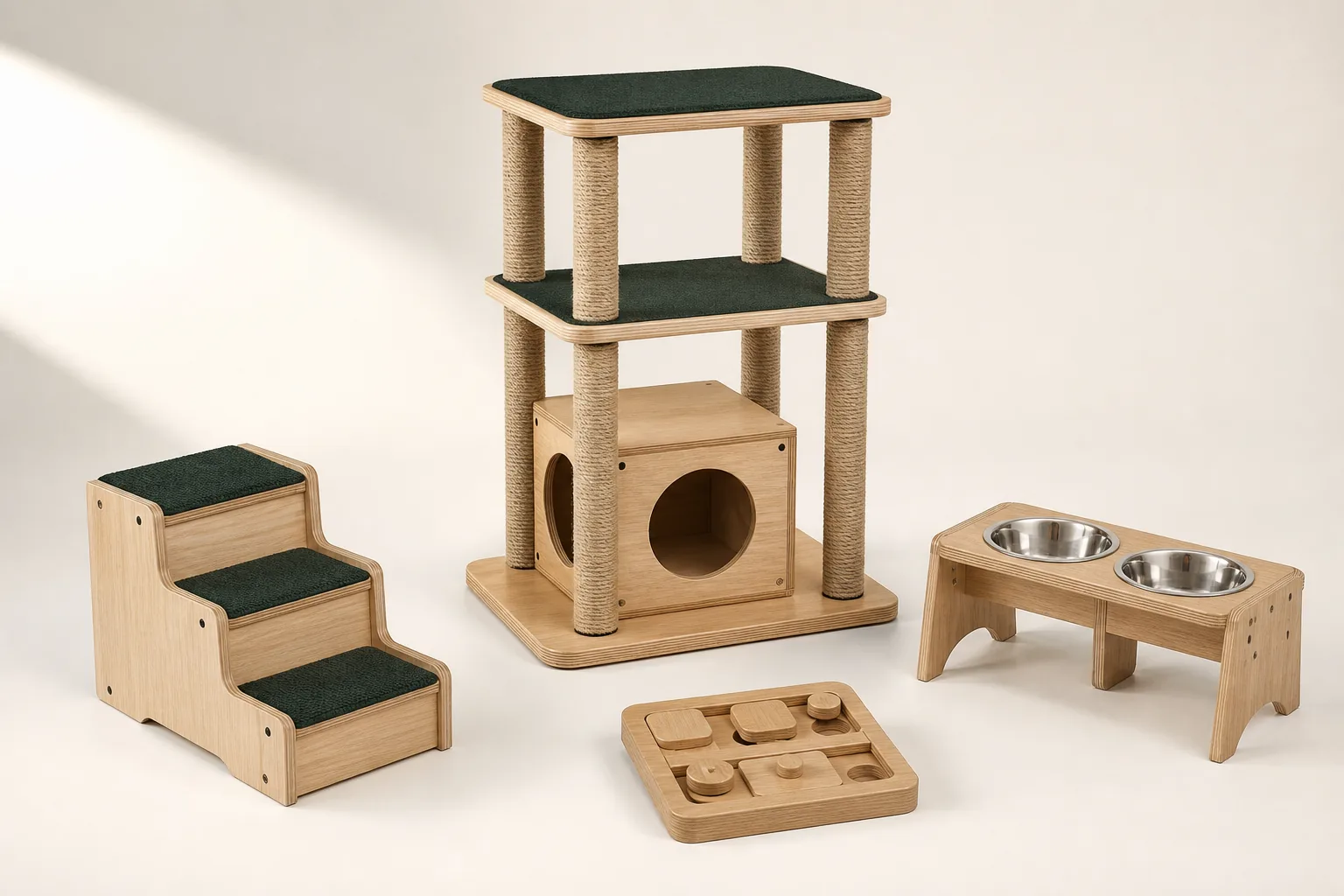
A quotation for a wooden cat platform needs a component specification. What is the platform made from? Which part supports it? How are the parts connected, and what finish covers the faces and edges? A brand buying team can use those questions to compare proposals before choosing an assembly sample.
This guide offers a purchasing brief for cat furniture. It does not identify the construction of a MEGATECH product or establish a load rating, service life or pet-safety result. Material descriptions provide background; the actual design and sample need their own evaluation.
Define the assembly before choosing a panel
Record whether the proposed product stands on the floor, attaches to a wall or forms part of a larger modular system. Identify the platform, supports and connections on the drawing. Ask the designer to state the intended use and which installation conditions the proposal assumes.
An evaluation plan should identify the actual configuration, relevant loading and stability questions, and who will set the methods and acceptance criteria. A board specimen and a fully assembled product answer different questions. The buyer should agree the scope with the designer and a qualified evaluator before treating a supplier's result as evidence for the proposed assembly.
Describe the material inside each component
The USDA Forest Products Laboratory distinguishes composites made from veneers, particles and fibres. Plywood is built mainly from veneer layers; medium-density fibreboard (MDF) belongs to the fibreboard family, while particleboard uses particles. The handbook also describes decorative plywood with different core constructions. A visible wood face therefore leaves the core to be identified. USDA Wood Handbook, chapter 11.
Use a separate material entry for each significant component:
| Proposed material | Details to request for the component |
|---|---|
| Solid wood | Species, specified grade, grain direction, dimensions and the supplier's material reference |
| Plywood | Actual core and layer construction, face specification, thickness, selected grade and supporting document |
| MDF | Exact panel product and grade, thickness, density specification if provided, and supplier documentation |
| Particleboard | Exact panel product and grade, thickness, surface/overlay and supplier documentation |
These entries help identify proposals; they do not rank every member of a material family. If two suppliers propose different constructions, ask each to explain how its selected material fits the same drawing and intended use. Keep the quoted document revision with the sample reference. A change from one panel product to another should be visible in the comparison.
Include moisture conditions in the brief
Wood exchanges moisture with its surroundings, and moisture content influences its properties and dimensional behaviour. The USDA discussion describes the roles of air humidity, temperature and the water already in the wood. USDA Wood Handbook, chapter 4.
Ask the supplier to identify the moisture or conditioning information used for the proposed material and sample. Record the expected indoor environment, storage assumptions and cleaning proposal. Agree which conditions the evaluation should represent; this guide supplies no universal moisture target or conditioning period for cat furniture.
Specify how the platform connects to its support
The USDA fastening chapter explains that joint design needs to account for wood properties along and across the grain, and dimensional changes linked to moisture. This is general engineering guidance, not an acceptance limit for a cat-furniture assembly. USDA Wood Handbook, chapter 8.
Request the connection detail on the drawing: fastener or insert reference, mating parts, hole locations and the supplier's assembly instructions. If a connection uses an engineered panel, ask for evidence applicable to that panel and fastening arrangement. Do not transfer a value for a solid-wood screw connection to an MDF edge or an unidentified insert.
Review the sample with its supplied hardware and instructions. Record the assembly sequence and any damaged hole, split edge, loose part or unclear step observed. These observations can guide a revision; they are not a substitute for the agreed structural evaluation. For a modular product, define which combinations the approval covers and how a later component change will be reviewed.
Give the finish its own specification
Ask for the coating or surface-system identity, colour reference and document revision. Identify which faces, edges, holes and joints receive treatment, and whether an overlay or edge band is part of the construction. Keep the coating supplier's application and cure instructions with the processor's record for the sample.
For cleaning, agree the proposed method and the condition in which the sample will be evaluated. Record any observed change to the surface or edge under those agreed conditions. A photograph can document appearance; it cannot establish coating identity, cure history or the suitability of the completed product. Any claimed result needs a report or recorded observation tied to an identifiable sample and the conditions evaluated.
Use an eight-field quotation and sample record
The following worksheet is our proposed procurement record. It is not a test standard or a claim that checks have passed.
| Record | Information to complete |
|---|---|
| Intended use | Product configuration, destination market, installation and cleaning assumptions |
| Component drawing | Platform/support identities, dimensions, drawing revision and permitted modular combinations |
| Material identity | Component-by-component species or panel product, grade, thickness and document revision |
| Moisture basis | Supplier's material/sample conditioning information and agreed evaluation conditions |
| Connection | Fastener/insert references, mating parts, hole details and assembly-instruction revision |
| Surface system | Coating/overlay/edge treatment, colour reference, supplier instructions and sample process record |
| Evidence | Sample/assembly ID, agreed question, method, conditions, report or observation and evaluation owner |
| Decision | Approved, conditional or on hold; scope, date, decision owner and unresolved items |
Consider a hypothetical revision: a supplier changes the platform's core while retaining the visible face. Give the proposed component a new reference, update the connection and surface entries where affected, then agree which evidence needs review. The earlier sample decision should remain attached to the earlier construction.
Bring the drawing, proposed material records and open connection questions to a project discussion. Our wood material guide provides broader context. Discuss a wooden pet-product specification with MEGATECH. Product-specific materials, manufacturing details and performance require confirmation for the actual project.