
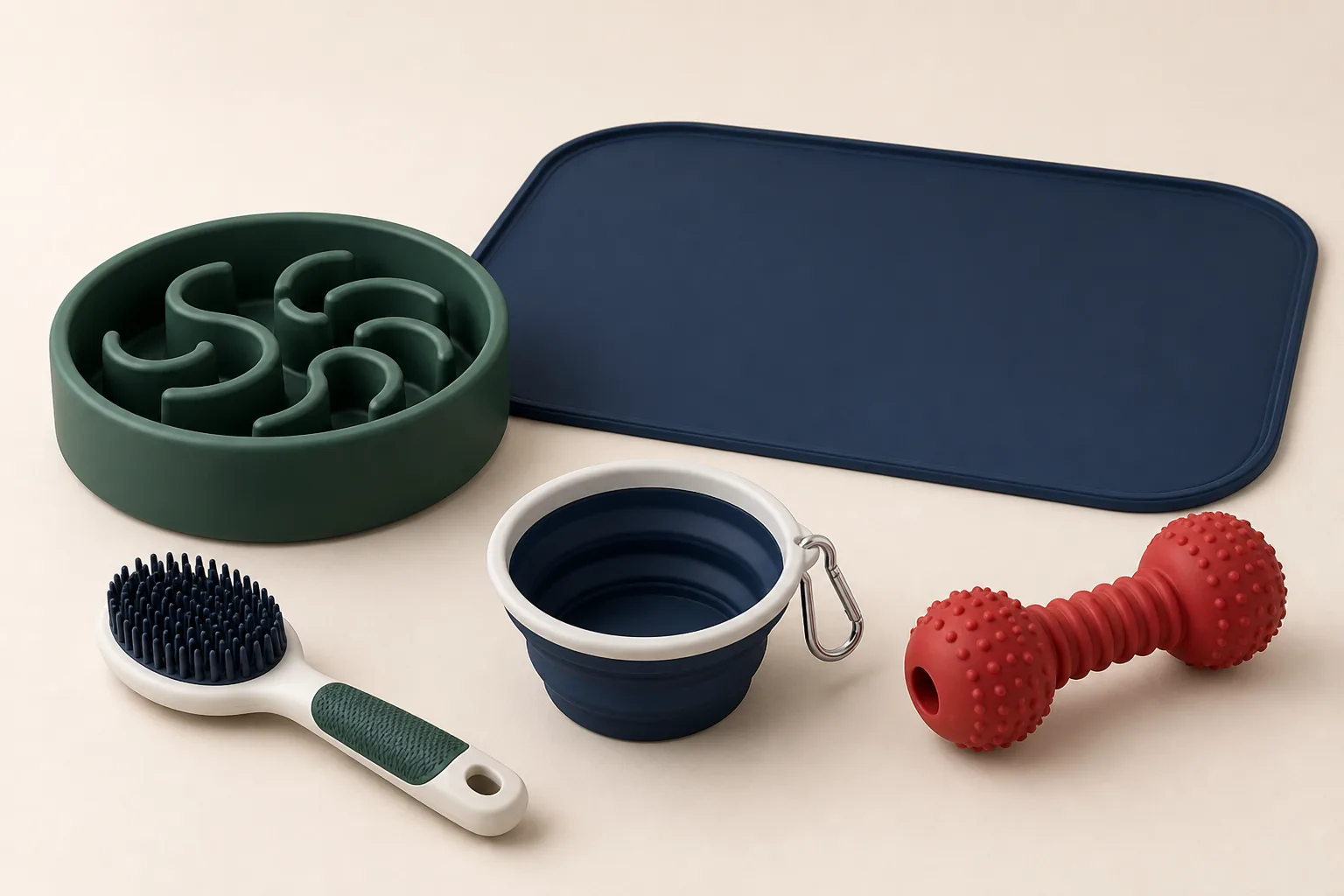
A quotation that says “silicone feeding mat” leaves several purchasing decisions open. Which compound is proposed? How will it be moulded and cured? What identifies the coloured sample that the buyer is reviewing? These questions belong in the same brief before quotations or samples are compared.
This guide helps a pet brand or retail sourcing team request that record. It does not identify the material used in a MEGATECH product or establish the suitability of a finished feeding accessory. The proposed fields below are procurement tools; the buyer and supplier still need to agree the intended use, destination market and evaluation scope.
Separate material form from cure chemistry
HCR means high-consistency rubber; LSR means liquid silicone rubber. WACKER's processing guide distinguishes those material forms and lists both peroxide-curing and platinum-addition-curing HCR ranges. Its LSR description covers two-component platinum-addition systems. A quote saying HCR therefore leaves the cure system open. WACKER material and processing guide
Record the proposed supplier and exact grade first. Put material form and cure system in separate fields, using the terminology in that grade's technical document. A supplier's product family, a hardness description or a photograph cannot fill in a missing grade reference.
The following comparison is a reading aid for supplier documents. It does not rank the routes or select one for a pet product.
| Quotation wording | What it identifies | What to request next |
|---|---|---|
| HCR | A material form | Exact grade and specified cure system |
| LSR | A material form | Exact grade, components and supplier's mixing instructions |
| Platinum-addition curing | Cure chemistry | Material grade, processing instructions and separate post-cure decision |
For liquid material, ask how the proposed components and colour package will be identified in the sample record. Dow describes LSR as a two-component system and separately describes pigment systems for metering and mixing equipment. Dow liquid silicone rubber overview
As a purchasing recommendation, keep the base compound, colourant or other additive references, formulation revision and component-mixing basis together. Ask for the selected supplier's compatibility and processing instructions. This is a request for traceable documents, not a mixing recipe.
Make post-curing an explicit decision
WACKER's general guide describes post-curing for removing volatile components and adjusting properties; it also discusses post-curing for platinum-addition rubber. Its separate LR 5040 brochure describes grades intended to eliminate that step, while warning that geometry and processing conditions can still affect the result. WACKER LR 5040 brochure
For the proposed feeding product, request a recorded decision to perform or omit post-curing. Identify the selected grade's document, the proposed process and the evidence to be reviewed for the actual part. The cited grade series is an example of why the decision needs a material reference; it is not a recommendation that MEGATECH uses it.
Do not turn a general processing example into a universal temperature or duration for every mat. Ask the processor to define the route and its validation for the proposed geometry and formulation. If a step is omitted, leave its justification visible in the approval record. If it is performed, identify the record that will show which sample underwent it.
Compare evidence for the same sample
A technical data sheet, a compound test specimen and a coloured moulded mat can be different evidence objects. When reading a reported property, record what was measured, the method and conditions, and whether the sample had further treatment. Ask how that evidence relates to the item under review. No finished-part result follows automatically from a material name.
Use this worksheet before choosing a production reference. It expands the material and processing fields in our feeding-mat sample approval guide.
| Record | Supplier entry to request | Buyer review question |
|---|---|---|
| Product and use | Product reference, drawing revision, intended use and market | Which requirements and checks apply to this brief? |
| Base compound | Manufacturer, exact grade and technical-document revision | Is this the material represented by the sample? |
| Form and cure | HCR or LSR; specified cure chemistry | Do these entries match the selected grade's documents? |
| Colour and additions | Colourant/additive references and formulation revision | Which combination was actually sampled? |
| Component mixing | Component identities and supplier's specified mixing basis | Which record connects preparation to this sample? |
| Moulding and curing | Proposed process and sample processing-record identifier | Can the processor identify how this revision was made? |
| Post-cure decision | Performed or omitted; rationale and relevant record | What supports that decision for this part? |
| Evidence object | Report ID, material/part identity, method, conditions and treatment state | Does the report answer the agreed question for the sample? |
| Revision and release | Sample ID, open issues, owner, decision and date | Is this revision approved, conditional or on hold? |
Review a colour change against the existing record
Consider a hypothetical range review: a buyer has reviewed a grey mat, then asks for a blue version. The base grade is proposed to remain the same. Ask the supplier to identify the colour-package change and give the new sample its own reference. Compare the formulation and process entries with the earlier record, then decide which affected checks need repeating. This example does not assert that the change creates a defect or that all checks must be repeated.
Record the changed item, the supporting document or observation, the person making the decision and any unresolved condition. Approval of the earlier sample should not silently answer a different formulation or processing proposal.
Bring the intended use, proposed grade, colour reference and open process questions to a sourcing discussion. Our silicone material guide provides broader context. Discuss a silicone material and process brief with MEGATECH. Product-specific materials, manufacturing details and performance require confirmation for the actual project.